Use this free body recomposition calculator to estimate calories, protein, and macros for losing fat while building or preserving muscle. It gives you a practical starting point based on your body fat, activity level, and goal.
Body Recomposition Calculator
Calculate your optimal calorie and macronutrient intake for body recomposition
Note: These are estimates. Adjust based on your progress over 4-6 weeks. For the Lean Mass formula, you’ll need to know your body fat percentage for more accurate results.
Which Formula?
Normal
Use the default formula based on body weight.
Lean Mass
If you know your body fat percentage, choose this formula. This will give more accurate results by using your body fat percentage in the calculation.
Additional Weekly Calories Burned
Body recomp requires consistent weight training (baseline is 3×30 minute sessions a week). If you are doing significantly more than this, then input the extra calories burned over the course of a week. Example; you are doing 4x 60-90 minute workout sessions, and doing 1-2 hours of bike work per week.
Adjust your goal
More fat loss – focus on fat loss, but compromise muscle gains. Even – good start point. More muscle gain – focus on muscle gains, but at risk of any fat loss ✨ Start with one goal, check progress after 4 weeks, and adjust.
Most people don’t realize this until months later: they lose 15–20 pounds… and still don’t look the way they expected.
The scale drops, but the mirror doesn’t change much. Strength feels lower. Clothes fit differently, but not better.
This usually happens because traditional dieting focuses only on weight loss, not body composition.
If your goal is to look leaner, firmer, and more defined (not just lighter), you need a different approach.
Many people search for a body recomp calculator, recomposition calculator, or even a quick body recomp calc when they realize traditional dieting isn’t enough. A well-built calculator for body recomposition helps align calories, protein, and training so you can lose fat while building or preserving muscle at the same time.
That’s where a structured plan and a well-designed body recomposition calculator become useful.
Body recomposition is about losing fat while preserving or building muscle at the same time. It requires precise calorie control, high protein intake, and progressive strength training. When those pieces align, your body changes shape, even if your weight barely moves.
Because recomposition depends heavily on your daily energy needs, it helps to estimate your maintenance calories first using our TDEE Calculator.
Research consistently shows that high protein intake combined with progressive resistance training is the primary driver of successful body recomposition.
This guide explains how body recomposition works, who it’s best for, common mistakes to avoid, and how to use a body recomposition calculator correctly.
Quick Answer: What This Body Recomposition Calculator Does
This body recomposition calculator estimates your maintenance calories, then adjusts them to support fat loss while preserving or building muscle. It also gives you protein and macro targets based on your body fat, activity level, and goal. For most people, body recomposition works best with high protein intake, consistent strength training, and either maintenance calories or a small deficit.
How This Body Recomposition Calculator Works
This body recomposition calculator first estimates your Basal Metabolic Rate (BMR) using established equations such as Mifflin-St Jeor or Katch-McArdle when body fat percentage is available. It then applies an activity multiplier to determine your Total Daily Energy Expenditure (TDEE). From there, it typically sets a small 10–15% calorie deficit to encourage fat loss while preserving muscle-building potential. Protein intake is set relatively high to support muscle protein synthesis and protect lean mass during the recomposition phase.
What Is Body Recomposition?
Body recomposition is the process of losing body fat while building or maintaining muscle at the same time. It usually involves a small calorie deficit, high protein intake (around 1.6 to 2.2 g/kg), and consistent progressive strength training over several months. Because muscle is denser and more metabolically active than fat, improving your muscle-to-fat ratio can change how your body looks even when the scale barely moves.
When you improve the ratio of muscle to fat, everything changes:
- Your metabolic rate increases
- Your strength improves
- Your shape becomes more defined
- Your energy becomes more stable
- Long-term fat loss becomes easier
This is why I prefer recomposition for most adults, especially those who want to look toned, firm, and fit.
Why Body Recomposition Is More Effective Than Traditional Weight Loss
Traditional weight loss focuses solely on the calorie deficit. While this is fundamental for fat loss, it often ignores the importance of preserving lean muscle mass. When you lose weight rapidly through severe calorie restriction, a significant portion of that loss can come from muscle. This leaves you with a softer look, a slower metabolism, and a higher chance of regaining the weight.
Body recomposition flips the script. Here’s why it’s so powerful:
- You Protect Your Metabolism: Muscle is metabolically expensive tissue. The more muscle you have, the more calories your body burns at rest. By building (or at least preserving) muscle while losing fat, you keep your metabolism firing on all cylinders.
- You Achieve a “Toned” Look: That sculpted, defined physique everyone wants isn’t just about having low body fat; it’s about having enough muscle underneath to create shape. Body recomposition builds that shape as you strip away the fat covering it.
- It’s Mentally Liberating: You break free from the tyranny of the scale. When you’re building muscle, which is denser than fat, the scale might not move much, or it might even go up! Instead, you learn to trust progress photos, how your jeans fit, and strength gains in the gym.
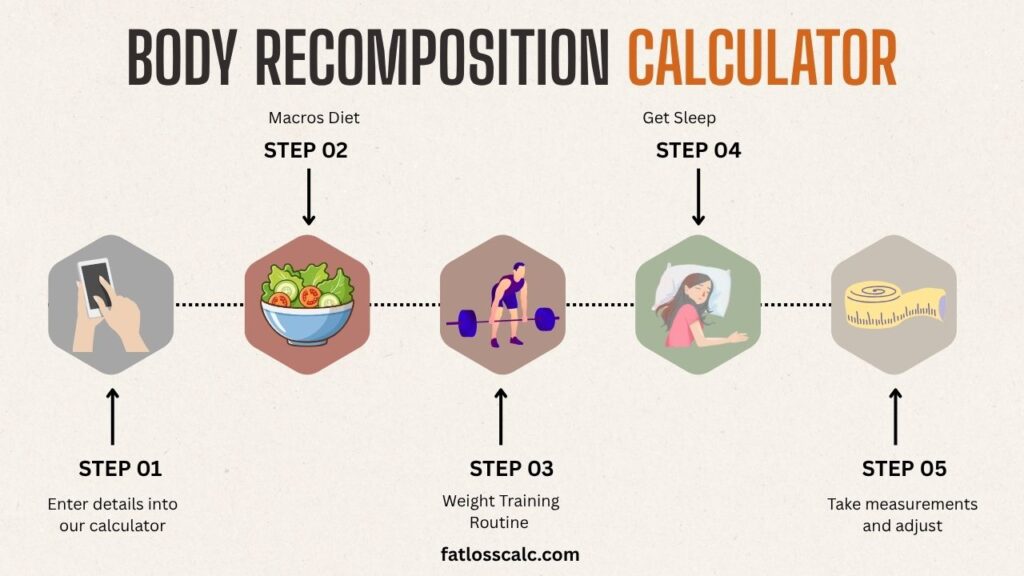
How to Do a Body Recomposition: Your 7-Step Blueprint
Ready to get started? This step-by-step process, centered around our powerful calculator, will set you up for success.
Step 1: Know Your Starting Point – Calculate Your Body Fat Percentage
You can’t map a route if you don’t know your starting location. The most crucial metric for body recomposition isn’t your total body weight, but your body fat percentage. This number is what the Body Recomposition Calculator uses to determine your precise calorie and macro needs.
If you don’t know your current body fat level, you can estimate it with our Body Fat Percentage Calculator before using the recomposition calculator.
Step 2: Choose Your Recomposition Goal
Now plug your details into the body recomposition calculator. If you were specifically looking for a recomposition calculator, this is the step where the tool starts tailoring your calorie and macro targets to your goal. You’ll usually see options like:
- More Fat Loss: A larger calorie deficit, favoring faster fat loss. Best for those with higher starting body fat percentages.
- More Muscle Gain: A perfect balance of a slight calorie deficit for fat loss and adequate fuel for muscle growth. This is the sweet spot for most people.
- Even: Eating at maintenance calories. Ideal for true beginners or those who are already lean and want to very slowly change their composition.
It estimates your calorie and macro targets based on your body fat percentage, activity level, and goal.
Step 3: Take Note of Your Calories and Macros
This is where your nutrition targets become specific and measurable. After you enter your stats and goal, this body recomposition calc will give you daily targets for:
- Calories: Your total energy intake for the day.
- Protein: The building block of muscle. This number is non-negotiable.
- Fats: Essential for hormone production and overall health.
- Carbohydrates: Your body’s primary fuel source for those intense workouts.
Write these numbers down! They are your new nutritional blueprint. Don’t just glance at them and move on. This data is your roadmap.
Step 4: Stick to a Consistent Workout Routine
You cannot out-train a bad diet, but you also cannot recompose your body without challenging your muscles! Nutrition builds the foundation, but exercise provides the stimulus for change.
Your routine should include:
- Strength Training: This is non-negotiable. Aim for 3-5 sessions per week, focusing on compound movements like squats, deadlifts, rows, and presses. Progressive overload, which means gradually increasing the weight or reps over time, is key.
- Cardio: Important for heart health and aiding your calorie deficit, but it shouldn’t be the main focus. We’ll cover how much cardio is ideal later on.
To maximize muscle growth during a recomposition phase, most sets should be performed within 1–3 reps of failure. Weekly training volume should generally fall between 10–20 hard sets per major muscle group, spread across at least two sessions per week.
Step 5: Track Your Macros Consistently
Knowing your numbers is one thing; hitting them is another. To ensure you’re giving your body the exact fuel it needs, you need to track your food intake. This isn’t about restriction forever; it’s about education and precision.
Use a good food tracking app and a food scale for accuracy, especially in the beginning. This will teach you about portion sizes and the macro content of foods. If you need help determining your numbers from scratch, you can always cross-reference with our dedicated Macro Calculator.
Step 6: Get Enough Quality Sleep
This is the most underrated performance-enhancing drug. When you sleep, your body repairs muscle tissue, regulates hormones (like cortisol and growth hormone), and restores its energy. Aim for 7-9 hours of quality sleep per night. Skimping on sleep can sabotage your fat loss and muscle gains, making the entire process much harder.
Step 7: Measure Your Results the Right Way
Throw out your old scale-centric mindset. Instead, use a multi-faceted approach:
- Progress Photos: Take pictures from the front, back, and side every 2-4 weeks under consistent lighting and clothing.
- How Your Clothes Fit: That loose waistband or tighter shirt sleeve is a fantastic indicator of progress.
- Strength Gains: Are you lifting heavier or doing more reps? That’s a direct sign of muscle growth!
- Tape Measure: Track the circumference of your waist, hips, arms, and thighs.
Re-assess your body fat percentage with our Body Fat Percentage Calculator every 8-12 weeks to see the hard data on your transformation.
How Long Does It Take to Recomp Your Body?
Patience is not just a virtue; it’s a requirement. Body recomposition is a slower, more quality-focused process than crash dieting. A sensible timeline is:
- Noticeable visual changes: 8-12 weeks for most people.
- Significant transformation: 6 months to a year or more.
Remember, you’re building something lasting. Consistency over time is what yields incredible results.
Who Should (and Should Not) Use a Body Recomposition Calculator
Body recomposition works best for:
- Beginners returning to strength training
- Individuals with moderate to high body fat
- People who want slower, sustainable changes
- Those who care more about body shape than scale weight
If you’re unsure whether your current weight is within a healthy range before starting a recomposition phase, you can check it using our Ideal Body Weight Calculator to establish a realistic reference point.
Individuals returning after time off training may benefit from muscle memory, meaning previously built muscle can be regained more quickly than it was originally developed.
It may not be ideal for:
- Advanced lifters already under ~12% (men) or ~20% (women) body fat
- Competitive bodybuilders in prep
- Individuals in very large calorie deficits
- People with medical or hormonal conditions affecting metabolism
As you approach your genetic potential for muscle mass, simultaneous fat loss and muscle gain becomes progressively more difficult.
General Body Fat Guidelines for Recomposition Potential
Men:
• Above 20% body fat → High recomposition potential
• 15–20% → Moderate potential
• Below 12–15% → Limited potential
Women:
• Above 30% body fat → High recomposition potential
• 22–30% → Moderate potential
• Below 20–22% → Limited potential
As body fat levels drop, the body becomes less willing to build muscle in a deficit.
This relates to nutrient partitioning — individuals with higher body fat tend to allocate a greater proportion of energy toward fat loss rather than muscle loss during calorie restriction.
Advanced trainees often respond better to structured bulking and cutting phases because muscle gain becomes slower as training age increases.
If you’re unsure, start conservatively. A mild 10–15% calorie deficit combined with strength training is safer and more sustainable than aggressive dieting.
Body Recomposition Calculator for Women vs Men: What Changes?
A body recomposition calculator for women may produce slightly different calorie targets than a body recomposition calculator for men because body fat percentage, lean mass distribution, and hormonal differences can affect energy needs.
However, the core principles remain the same:
- Moderate calorie control
- High protein intake
- Progressive resistance training
The difference is precision — not strategy.
How Much Protein Should I Eat?
For body recomposition, most people should aim for about 1.6 to 2.2 grams of protein per kilogram of body weight per day.
Protein stimulates muscle protein synthesis, the biological process responsible for repairing and building new muscle tissue after resistance training. It also helps preserve lean mass in a calorie deficit and improves satiety, which makes it easier to stick to your calorie target.
The Body Recomposition Calculator will give you a more personalized number, but 1.6 to 2.2 grams per kilogram is a strong evidence-based range for most people.
Research suggests that protein needs may increase during a calorie deficit. A large meta-analysis of resistance training studies found that intakes around 1.6 g/kg/day maximize muscle growth for most individuals, with slightly higher intakes potentially beneficial during calorie restriction.
Some evidence supports intakes closer to 2.3–3.1 grams per kilogram of lean body mass when aggressively cutting to preserve muscle. For moderate body recomposition, staying near the upper end of the 1.6–2.2 g/kg range is typically sufficient.
If you’re very active or in a larger deficit, err on the higher end of that range.
If I Do Extra Workouts, Do I Need to Account for the Calories?
This is a great question. The calorie target from the Body Recomposition Calculator already factors in your activity level. If you suddenly add a bunch of extra cardio or a long hike, you might feel overly fatigued or hungry.
Listen to your body. If you’re consistently adding significant activity (e.g., training for a sport), you may need to adjust your intake slightly. For the occasional extra workout, you probably don’t need to change anything. The goal is consistency, not daily perfection.
For additional help, use our calorie burn calculator. Don’t forget you’re focusing on extra calories burned across the week, not just in a single workout.
How Many Calories Should I Eat a Day for a Body Recomposition?
Most people do best at maintenance calories or a small calorie deficit of about 10% to 15% below maintenance for body recomposition.
The exact number depends on your age, weight, height, body fat percentage, activity level, and training status. That’s why a generic Google search usually won’t give you a useful number.
A dedicated calculator for body recomposition gives you a much more useful starting point because it factors in body fat, activity level, and the balance between fat loss and muscle retention.
The Body Recomposition Calculator uses proven formulas to determine your personalized calorie needs, creating the precise energy balance needed to fuel workouts while encouraging your body to use stored fat for energy.
Some people search for a recomp calculator or recomp calorie calculator when trying to determine the calorie level that allows fat loss without sacrificing muscle.
How to Calculate Calories for Body Recomp
If you’re curious how the math works, the calculator first estimates your Basal Metabolic Rate (BMR), which is the calories you burn at rest. It then multiplies that by an activity factor to estimate your Total Daily Energy Expenditure (TDEE).
For a moderate body recomposition, it will place you in a slight deficit (around 10-15% below your TDEE) or sometimes at your exact TDEE. Research suggests that once daily calorie deficits exceed roughly 300–500 calories, the likelihood of building muscle decreases significantly. Smaller deficits improve the probability of recomposition, especially for intermediate trainees. Aggressive calorie restriction can trigger metabolic adaptation, where the body reduces energy expenditure and prioritizes survival over muscle growth.
The high protein intake and strength training signal your body to use the caloric deficit (and stored fat) for energy while using the dietary protein and energy surplus from other nutrients to build muscle.
Daily movement outside structured workouts, often called NEAT (non-exercise activity thermogenesis), can significantly influence total calorie expenditure. Differences in walking, standing, fidgeting, and general activity levels often explain why two people following the same Body Recomposition Calculator targets can experience different rates of fat loss.
In simple terms: maintenance calories support muscle growth, a small deficit promotes fat loss, and high protein intake helps preserve lean mass during both.
Is a Body Recomp Calculator Different From a Standard Macro Calculator?
A body recomp calculator is a more specialized version of a standard macro calculator. While a regular macro calculator works well for general fat loss or muscle gain, a body recomposition calculator is better suited to the specific goal of losing fat while building or preserving muscle at the same time. It also tends to give more useful protein guidance for that goal.
That’s why a dedicated body recomp calculator is often more useful for this goal than a generic macro tool.
A body recomp calculator is specifically structured to balance muscle gain and fat loss simultaneously, rather than focusing only on weight loss or muscle gain in isolation.
How Much Cardio for a Body Recomposition?
Cardio is your helper, not your hero. Too much can interfere with recovery and muscle growth. Aim for:
- 2-3 sessions of moderate-intensity cardio (like brisk walking or cycling where you can hold a conversation) for 20-40 minutes.
- OR 1-2 sessions of High-Intensity Interval Training (HIIT) per week.
Your primary focus should always be on your strength training performance.
Common Body Recomposition Mistakes
1. Eating Too Large of a Deficit
Many people assume faster fat loss equals faster results. But large calorie cuts reduce recovery, lower training performance, and increase muscle loss risk.
Fix: Keep your deficit between 10–15% below maintenance.
2. Underestimating Calories
Healthy foods still contain calories. Eyeballing portions often leads to stalled progress.
Fix: Use a food scale for 2–4 weeks to calibrate portion awareness.
3. Doing Too Much Cardio
Excessive cardio interferes with muscle recovery and increases fatigue.
Fix: Prioritize strength training first. Cardio supports the process, but it shouldn’t lead it.
4. Changing Calories Every Week
Impatience causes people to adjust too frequently.
Fix: Evaluate progress in 3–4 week blocks before making changes.
5. Ignoring Sleep and Stress
High cortisol levels impair recovery and fat loss.
Fix: Aim for 7–9 hours of consistent sleep.
How to Adjust Your Body Recomposition Plan
After 4 weeks, review your progress before making changes. If you’re unsure how large your calorie reduction should be, you can estimate it using our Calorie Deficit Calculator.
- No fat loss AND no strength gain → Reduce calories by 5–10%
- Strength dropping consistently → Increase carbohydrates slightly (25–40g/day)
- Energy extremely low → Reassess sleep and stress before cutting more calories
- Waist shrinking but weight stable → Stay consistent
Re-run the Body Recomposition Calculator every 8–12 weeks if your body weight or body fat percentage changes meaningfully.
Adjust slowly. Extreme changes usually backfire.
Body recomposition is a long-term strategy that prioritizes muscle retention and fat loss simultaneously. It requires consistent strength training, adequate protein intake, controlled calorie targets, and patience. Results build gradually over months, not weeks.
Final Thoughts
A body recomposition calculator is a planning tool, not a shortcut.
It gives you structure. But results still come from consistent strength training, adequate protein intake, controlled calorie targets, and patience over time. Many people start by calculating their maintenance calories, adjusting them with a small deficit, and structuring macros correctly using tools like our TDEE Calculator and Macro Calculator.
If you want a structured starting point, you can use this free body recomposition calculator, sometimes called a body recomp calculator, recomposition calculator, or quick body recomp calc, to estimate your calorie and macro targets. Then focus on consistent execution.
Whether you call it a body recomp calculator, a recomp calculator, or a recomposition calculator, the goal is the same: align calories, protein, and strength training to improve body composition over time.
Track performance. Monitor waist measurements. Take progress photos. For detailed guides on fat loss, muscle building, and calorie planning, visit the Fatlosscalc Blog.
Body recomposition rewards consistency more than intensity.
Frequently Asked Questions

View Sources
- Bonilla D., et al. “New Insights and Advances in Body Recomposition.” Frontiers in Nutrition. 2024. Link
- Barakat C., Pearson J., et al. “Body Recomposition: Can Trained Individuals Build Muscle and Lose Fat at the Same Time?” Strength & Conditioning Journal. 2020. Link
- “How to Lose Fat and Gain Muscle for Body Recomposition.” Healthline. Updated 2025. Link
- Nunes E. A., et al. “Systematic review and meta-analysis of protein intake to improve lean body mass.” Journal of Cachexia, Sarcopenia and Muscle. 2022. Link
- Pereira-Monteiro M. R., et al. “Functional and Combined Training Promote Body Recomposition and Lower Limb Strength in Postmenopausal Women: A Randomized Clinical Trial and a Time Course Analysis.” Healthcare. 2024. Link